
Website for restaurants where the menu and hours load instantly.
A website for restaurants has to make the basics instant, with the menu, hours, and a booking all within reach in seconds. Your site is a guest's first taste of the place, so I make it fast and genuinely appetizing, and it ranks well locally while climbing further as it builds authority. It also encourages happy guests to leave reviews, so your reputation grows along with your visibility.
By Jonah Chegarnov · Updated
Why Restaurant sites are different.
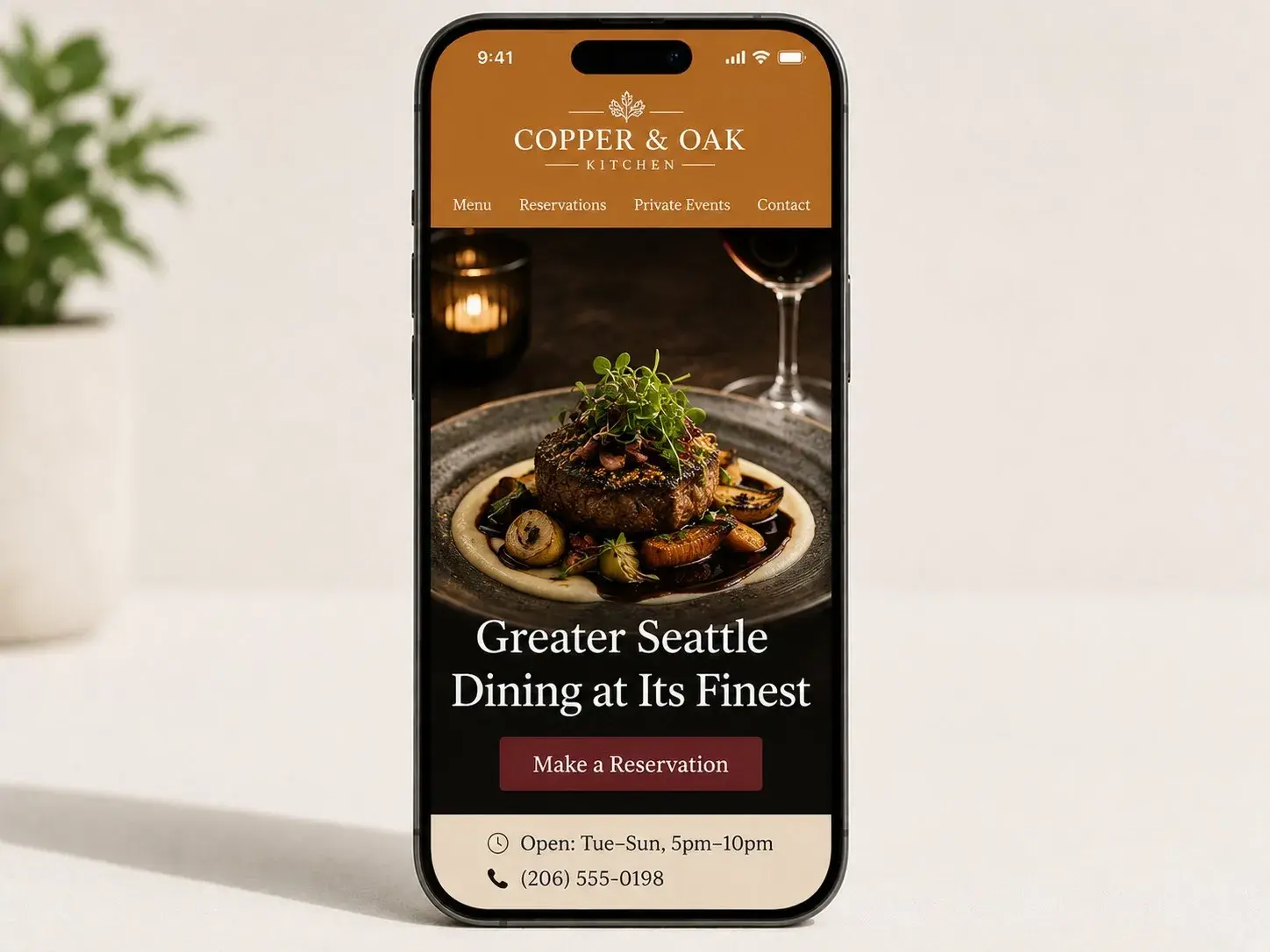
Restaurant website conversion is unique because the conversion event is usually a fast decision made on a phone: "can I see the menu, are they open right now, and how do I get a reservation or directions?" Most restaurant sites fail this test by burying the menu behind a PDF download, using carousels that load slowly, or showing hours that aren't current. The fix is brutal simplicity: menu as visible text (not a PDF), hours pulled from a single source of truth that updates automatically, reservation integration as one tap, and directions surfaced above the fold. Beyond the mobile basics, the secondary work is photo schema for dishes (which AI assistants surface on "best [cuisine] in [neighborhood]" queries), Google Posts integration for daily specials, and online ordering integration where applicable.
What goes into a great website for restaurants.
- Menu as visible HTML text, not a PDF
- Menus rendered as on-page HTML so they're indexable, mobile-readable, and surfaceable in search and AI Overview results. PDF menus are conversion killers.
- Hours from a single source of truth
- Hours managed in one place and pushed to the site, GBP, and reservation system simultaneously. Outdated hours are the most common restaurant-site failure.
- Reservation integration
- OpenTable, Resy, SevenRooms, or Tock integrated as one-tap booking from the homepage and menu pages. Reservation friction is conversion friction.
- Online ordering integration where relevant
- Toast, Square Online, ChowNow, or direct-DoorDash integration for restaurants doing takeout/delivery volume. Surfaced on the menu page where the intent already lives.
- Photo schema for signature dishes
- Real, well-lit photos of menu standouts with proper schema markup. AI assistants surface dish photos on "best [cuisine] in [neighborhood]" queries when the schema is right.
- Google Posts integration for specials
- Daily/weekly specials posted to GBP automatically from the site CMS. Posts are an underused conversion lever for restaurants specifically.
How I approach Restaurant web design.
Every site I build runs on the same modern, server-rendered stack, the same one powering chegtech.com. That's deliberate. The default for local-business sites is WordPress with a page builder, and the builder layer tanks Core Web Vitals and ceiling SEO. Custom-built means faster, cleaner, and built to rank from day one.
A new website doesn't earn Google's full trust overnight. Search engines tend to be cautious with newer domains for the first few months, so I build the foundation correctly from day one, with clean structure, proper SEO, and the right signals in place. That way, as your domain ages and gains authority, your site is already positioned to climb instead of playing catch-up.
SEO + AEO Built In
- Local SEOGBP-aligned content, NAP consistency, citation cleanup, neighborhood pages
- Technical SEOCore Web Vitals in the 90s, semantic HTML, structured data, clean sitemap
- AEO OptimizationFAQ schema, AI-Overview-ready content, ChatGPT/Perplexity citation patterns
- Mobile-First Design70%+ of service searches are mobile, so every page is tested at phone width first
- Schema.org MarkupLocalBusiness, FAQPage, Service schema embedded site-wide
- Conversion TrackingGA4 + GTM + form-submission events wired to real outcomes, not vanity clicks
Tech Stack
- Next.jsReact framework, server-rendered
- AstroContent-first static sites
- TypeScriptType-safe JavaScript
- Tailwind CSSUtility-first styling
- Sveltia CMSGit-based content editor
- NetlifyEdge hosting & deploys
- Cloudflare TurnstileForm spam protection
- Schema.org JSON-LDStructured data for search + AI
- Google Tag ManagerAnalytics + conversion events
- SE RankingKeyword research + rank tracking
- BrightLocalLocal rank tracking + citation audits
- GitHubVersion control + deploy triggers
Menu + hours + reservation in 90 seconds, or it lost
A restaurant site passes or fails one test, menu, hours, and reservation visible in seconds on a phone, so I would build everything to clear it. Menu in real text instead of a PDF, hours from a single source of truth, reservations one tap, and dish photo schema for the 'best [cuisine] in [neighborhood]' queries, for an independent in the Auburn, Tacoma, or Puyallup corridor whose current site is quietly costing reservations.
The Greater Seattle Restaurant market.
Greater Seattle's restaurant landscape rewards different conversion approaches by submarket. Capitol Hill, Ballard, and Fremont skew toward Resy / Tock for reservations and have heavier OpenTable competition. South King and Pierce restaurants (Auburn, Kent, Federal Way, Tacoma, Puyallup) lean more on Google Maps direct calls and walk-ins. Eastside (Bellevue, Redmond) is dense with chain competition where the independent's local SEO has to do extra work to surface.
More on the South King County marketCommon Restaurant web design questions.
PDFs aren't fully indexed by search engines, don't render predictably on mobile, and add download friction. HTML menus rank for menu-item queries ("birria tacos auburn," "pad see ew federal way"), look right on every device, and let AI assistants extract dishes correctly. PDF menus are one of the highest-impact things to fix on a restaurant site.
Yes, embed widgets and deep-link reservation buttons for all of the major platforms. The reservation should be one tap from the homepage and the menu page, not buried in a "reservations" submenu.
Toast and Square Online integrate as direct on-site ordering (no third-party commission). DoorDash, Grubhub, and Uber Eats integrate as deep-link buttons. The choice depends on your existing POS and whether direct ordering is worth the operational overhead vs the third-party commission.
The build is $2,500 one-time, with hosting and maintenance at $150 a month, which covers the admin tools so updating hours and menu items takes about ten minutes, not a developer call. Local SEO and content retainers run $350 to $850 a month. Most restaurant sites launch in 2 to 3 weeks. See pricing →
What clients say about working with me.
5.0 rating across 14 Google reviews.
ChegTech was the best fit for my Business! Took every detail into consideration, and helped me turn my vision into a reality. I dreaded the thought of needed to get a website built for my HVAC Business, and between the hundreds of spam calls and pushy sales rep. I took the time to research and call a few Web designers, ChegTech was the perfect fit. Not only are they local to me, but they made sure everything was done to my satisfaction. Love the Website, and will continue to recommend ChegTech to everyone I come across!
Dennis S.
Owner, Pinnacle Air Control
ChegTech, did a fantastic job for glass installation company. Super easy to work with, would highly recommend for anyone looking to get a website done right. Will use them again for any future business endeavours.
Tima C.
Owner, IGo Green
I had an amazing experience working with this website developer! From start to finish, they were professional, responsive, and incredibly skilled. They took the time to understand exactly what I wanted and turned my vision into a beautiful, modern, and fully functional website. The design was clean and user-friendly, the site runs smoothly on all devices, and everything was completed on time. Communication throughout the project was excellent, and they were always willing to make adjustments and provide helpful suggestions. I highly recommend this developer to anyone looking for high-quality web design and development services. Truly a 5-star experience!
Daniel K.
Owner, Velare Remodeling

Every Restaurant site is designed, coded, and optimized by Jonah Chegarnov. No subcontractors, no account managers, no handoffs. Founder of ChegTech · Web Designer & SEO in Auburn, WA.
More about JonahReady to talk about your Restaurant project?
Project-by-project. No retainers, no contracts. Starting at $2,500.
ChegTech · Auburn, WA 98001 · serving Greater Seattle · (206) 940-8704 · jonah@chegtech.com