
Website for plumbing companies built for the emergency call.
A website for plumbing companies has to look professional and show up the moment someone has water on the floor. I handle the whole thing, so you're not juggling vendors to get there. Your site tells a stressed homeowner they've found a real pro within seconds, ranks well locally and keeps climbing as it builds authority, and encourages happy customers to leave reviews that build your reputation while you focus on the work.
By Jonah Chegarnov · Updated
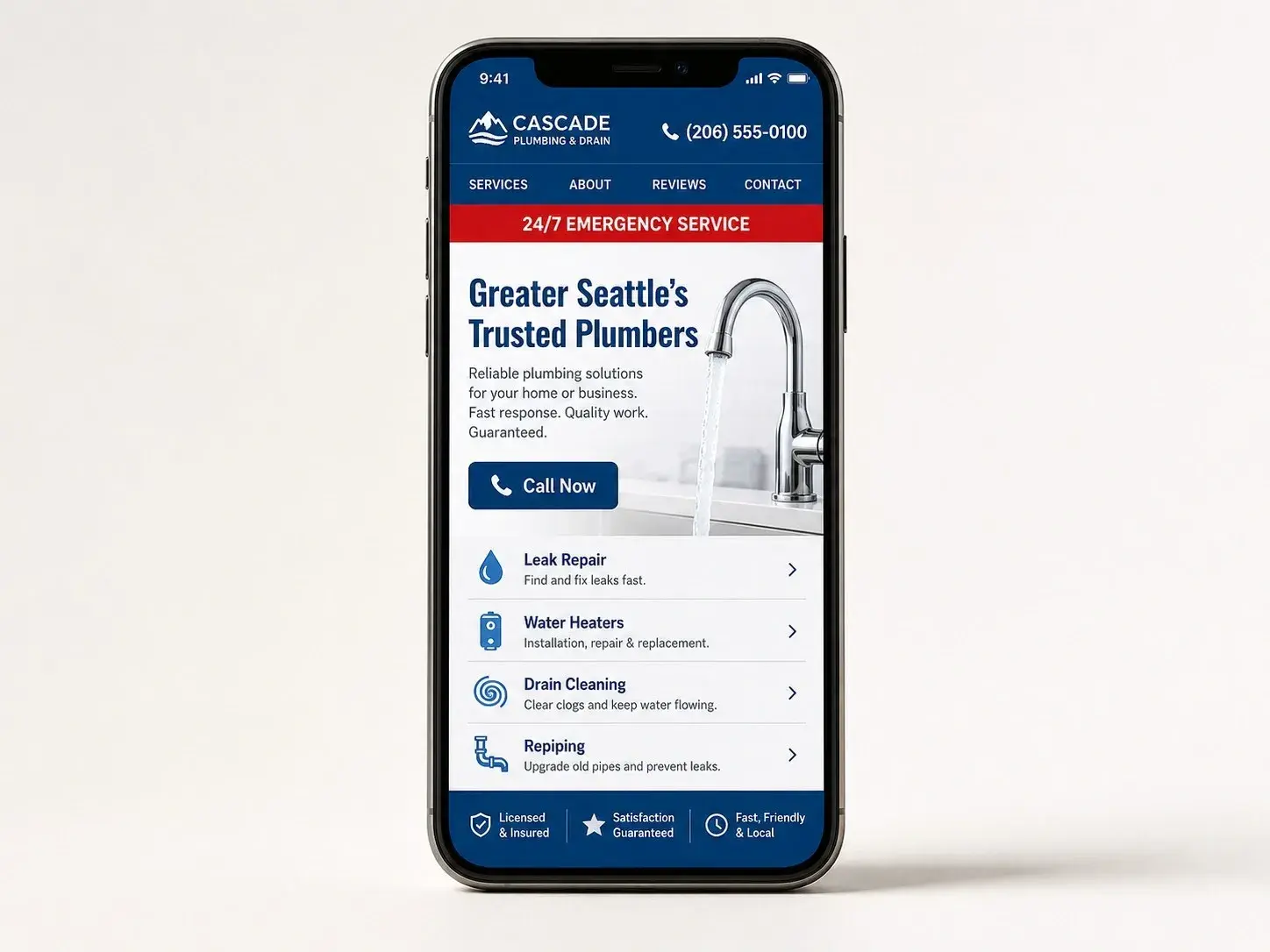
Why Plumbing sites are different.
Plumbing search skews further toward mobile emergency intent than almost any other trade. The homeowner is literally standing in water when they search. The implication is that the desktop experience barely matters; the mobile experience above the fold is the entire conversion. Beyond mobile-first, the trust signals that actually move plumbing conversions are licensing (WA L&I number visible), bonding, and a same-day or 24/7 availability claim that's specific rather than vague. Generic "emergency service available" doesn't convert. "Plumber on-call within 30 minutes, South Hill to Federal Way" does. Sites that get this right convert at multiples of the templated competition. Getting plumbing leads online comes down to three things working together: ranking for the "near me" and emergency searches, a phone-first layout that turns those visits into calls, and the real Google reviews on the page closing the trust gap, and I build all three into the same site.
What goes into a great website for plumbing companies.
- Phone-first mobile header
- Phone number as a
tel:link visible above the fold on every page, with one-tap dialing. The single highest-ROI element for plumbing. - Specific availability claim, not vague
- "30-minute dispatch in South Hill" beats "24/7 service available" because the specificity is what builds trust under pressure.
- WA L&I and bonding display
- License number, bond amount, and insurance prominent in the footer of every page, not buried on the about page. Customers under pressure look for these before calling.
- Service-specific pages with realistic price ranges
- Water heater install, drain cleaning, pipe repair, gas line, each its own page with cost ranges that pre-qualify leads instead of scaring them off.
- Dispatch-software-friendly intake
- Contact form and quote-request fields post cleanly to ServiceTitan, Housecall Pro, or Jobber via webhook or email-to-ticket, so booking requests land in dispatch with no double-entry on your end.
- Financing for the big-ticket repairs
- Whole-house repipes and tankless water heater conversions are the high-LTV jobs. Financing partner display on those pages directly increases close rates.
How I approach Plumbing web design.
Every site I build runs on the same modern, server-rendered stack, the same one powering chegtech.com. That's deliberate. The default for local-business sites is WordPress with a page builder, and the builder layer tanks Core Web Vitals and ceiling SEO. Custom-built means faster, cleaner, and built to rank from day one.
A new website doesn't earn Google's full trust overnight. Search engines tend to be cautious with newer domains for the first few months, so I build the foundation correctly from day one, with clean structure, proper SEO, and the right signals in place. That way, as your domain ages and gains authority, your site is already positioned to climb instead of playing catch-up.
SEO + AEO Built In
- Local SEOGBP-aligned content, NAP consistency, citation cleanup, neighborhood pages
- Technical SEOCore Web Vitals in the 90s, semantic HTML, structured data, clean sitemap
- AEO OptimizationFAQ schema, AI-Overview-ready content, ChatGPT/Perplexity citation patterns
- Mobile-First Design70%+ of service searches are mobile, so every page is tested at phone width first
- Schema.org MarkupLocalBusiness, FAQPage, Service schema embedded site-wide
- Conversion TrackingGA4 + GTM + form-submission events wired to real outcomes, not vanity clicks
Tech Stack
- Next.jsReact framework, server-rendered
- AstroContent-first static sites
- TypeScriptType-safe JavaScript
- Tailwind CSSUtility-first styling
- Sveltia CMSGit-based content editor
- NetlifyEdge hosting & deploys
- Cloudflare TurnstileForm spam protection
- Schema.org JSON-LDStructured data for search + AI
- Google Tag ManagerAnalytics + conversion events
- SE RankingKeyword research + rank tracking
- BrightLocalLocal rank tracking + citation audits
- GitHubVersion control + deploy triggers
Direct transfer from the HVAC playbook
Plumbing is the most direct analog to the Pinnacle Air Control rebuild, same mobile-emergency search behavior, same service-area dynamics, so my approach reuses what worked there. I would lead with the emergency-call path, build FAQ schema and location pages across the Auburn, Kent, and Renton corridor, and target the real questions ('why is my water heater leaking') that drive high-intent search, the exact moves that took Pinnacle from rank 70 to 9.
The Greater Seattle Plumbing market.
Plumbing demand in Greater Seattle peaks twice: January cold snaps (frozen pipe bursts in older homes that don't have insulated attics) and the spring thaw. Active markets: Auburn, Federal Way, Kent, Renton, and Tacoma, where mid-century housing stock means a lot of galvanized pipe still needs replacing. Pierce County's well-water properties out toward Bonney Lake add a distinct pump and softener category.
More on the South King County marketCommon Plumbing web design questions.
The contact form posts to a webhook or email-to-ticket endpoint, which works for ServiceTitan, Housecall Pro, Jobber, and most of the major dispatch tools. Full two-way sync (vehicle GPS, job status writes) is out of scope for a flat-rate build, most plumbing clients run the form into their normal intake and find that's enough.
We surface the availability claim that's actually true, if you have on-call coverage from 6am to 10pm with weekend rotation, the site says exactly that. Overpromising 24/7 service that's actually voicemail-after-hours destroys trust the first time it gets tested. Be specific about what you really cover.
Static price ranges, yes, "water heater install $1,800 to $3,400 depending on tank size and venting" is honest, useful, and pre-qualifies leads. Live pricing tied to inventory or dispatcher availability is out of scope for a flat-rate build.
LSAs are worth running for plumbing. They pay per lead, not per click, and the Google Guaranteed badge converts well. The site work supports LSAs but doesn't replace them. We can wire LSAs into the same analytics so you see organic + paid lead flow side by side. See SEO services →
What clients say about working with me.
5.0 rating across 14 Google reviews.
Loved working with Jonah. Website was phenomenal and I was able to get all the features I wanted.
Nathan M.
Verified Google review
Very good job at making websites I very recommend him for all works.
Lucas M.
Verified Google review
ChegTech was the best fit for my Business! Took every detail into consideration, and helped me turn my vision into a reality. I dreaded the thought of needed to get a website built for my HVAC Business, and between the hundreds of spam calls and pushy sales rep. I took the time to research and call a few Web designers, ChegTech was the perfect fit. Not only are they local to me, but they made sure everything was done to my satisfaction. Love the Website, and will continue to recommend ChegTech to everyone I come across!
Dennis S.
Owner, Pinnacle Air Control

Every Plumbing site is designed, coded, and optimized by Jonah Chegarnov. No subcontractors, no account managers, no handoffs. Founder of ChegTech · Web Designer & SEO in Auburn, WA.
More about JonahReady to talk about your Plumbing project?
Project-by-project. No retainers, no contracts. Starting at $2,500.
ChegTech · Auburn, WA 98001 · serving Greater Seattle · (206) 940-8704 · jonah@chegtech.com