
website for excavation companies in Greater Seattle
Website for excavation companies built to win bids.
A website for excavation companies carries a bigger, slower, higher-stakes sale than the emergency trades, and it has to look the part. A general contractor or homeowner choosing who moves the earth on their project is vetting your equipment, your bonding and insurance, and the scope of jobs you've actually finished. I build sites that put that proof up front, the machines, the credentials, a project gallery measured in scope rather than square feet, and real Google reviews from past clients, so you get shortlisted for the work worth bidding.
By Jonah Chegarnov · Updated
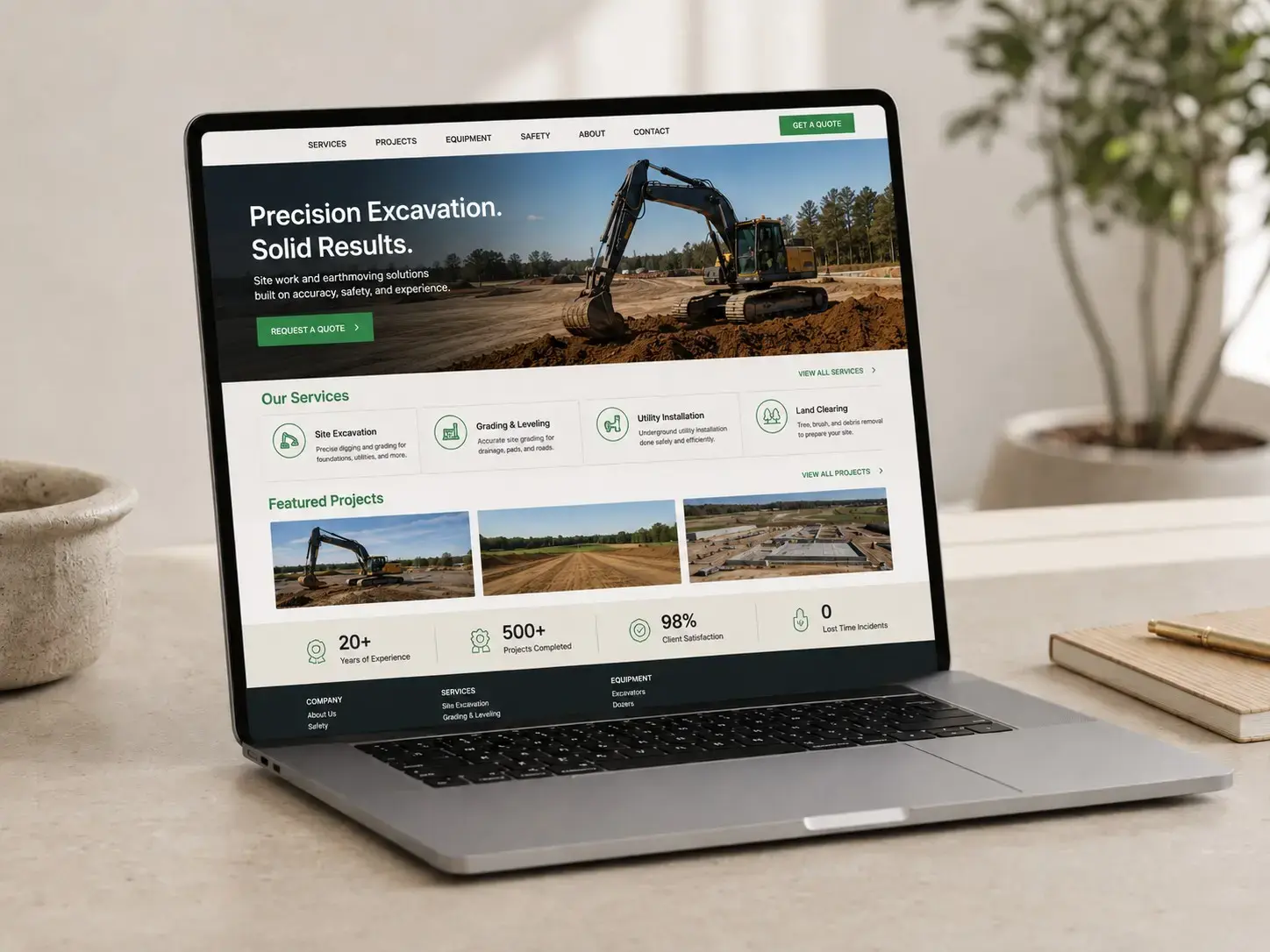
Why Excavation sites are different.
Excavation doesn't sell like an emergency trade, and a site borrowed from one will quietly cost you the good bids. Nobody picks an excavator off a panicked 2 a.m. search. A general contractor or developer researches for weeks, comparing equipment fleets, bonding limits, insurance, and the scale of past jobs before anyone reaches out. The work itself is broad. Site prep, mass grading, utility and septic, demolition, and land clearing are different services with different buyers, and lumping them into one page reads as a one-person operation with a rented mini-ex. Trust signals do the heavy lifting: bonding and insurance figures, equipment lists, 811 utility-locate fluency, and a project gallery that shows scope and scale, not just a tidy finished slab. The site's job is to get you shortlisted for the high-ticket work, where the sales cycle is long and the margins are real.
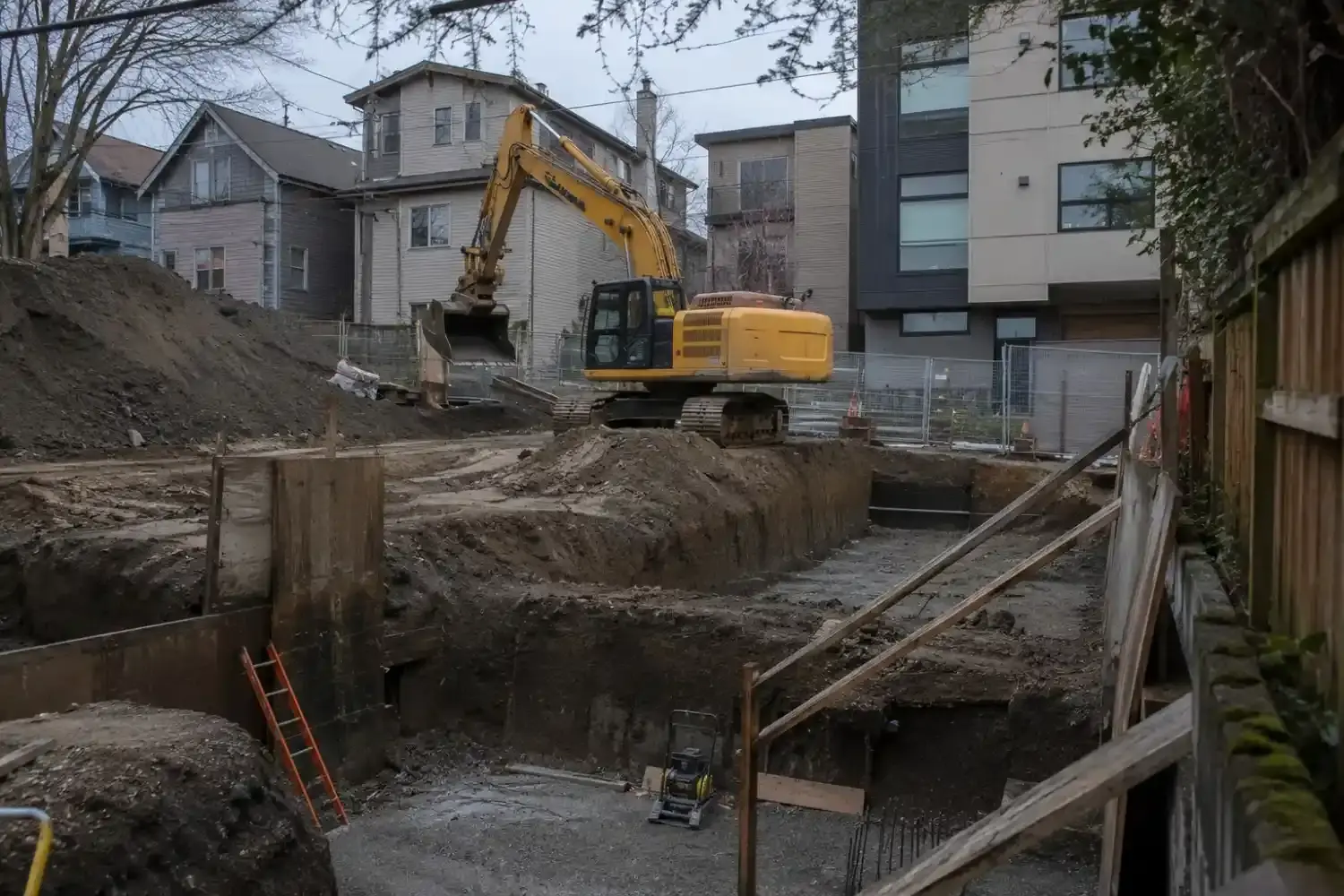
What goes into a great website for excavation companies.
- Site prep, grading, utility, and demolition broken out by scope
- Mass grading for a subdivision and a backyard drainage fix are different buyers. Separate pages for site prep, grading, utility and septic, demolition, and land clearing rank for the right searches and signal the real breadth of your fleet. The navigation puts each service one click from the homepage, so a general contractor scoping a bid finds the exact capability they're vetting instead of bouncing off a wall of generic copy.
- Bonding, insurance, and equipment proof above the fold
- The figures a general contractor screens for, like bond capacity, liability and umbrella coverage, and licensing, surfaced up front alongside an equipment list. It's the fastest way to get past the first cut on a commercial bid.
- A project gallery measured in scope, not square footage
- Wide shots of cut-and-fill, finished pads, trenched utility runs, and cleared lots, with the project context (acreage, yardage moved, timeline) that tells a developer you've handled work at their scale.
- A bid and project-intake form built for long sales cycles
- Capture project type, site address, rough acreage or scope, timeline, and whether plans and a survey exist, so you can qualify a real bid from a tire-kicker before committing estimating hours.
- 811 and permitting copy that signals you know the rules
- Plain-language sections on utility-locate, grading permits, erosion control, and haul-off that tell a property owner you operate by the book, the contractor who won't leave them with a stop-work order.
- Excavation service schema mapped to each capability
- GeneralContractor LocalBusiness schema with a Service entry per capability and accurate areaServed, so search and AI Overview surface you for "land clearing" or "septic excavation" distinctly, not one generic listing.
How I approach Excavation web design.
Every site I build runs on the same modern, server-rendered stack, the same one powering chegtech.com. That's deliberate. The default for local-business sites is WordPress with a page builder, and the builder layer tanks Core Web Vitals and ceiling SEO. Custom-built means faster, cleaner, and built to rank from day one.
A new website doesn't earn Google's full trust overnight. Search engines tend to be cautious with newer domains for the first few months, so I build the foundation correctly from day one, with clean structure, proper SEO, and the right signals in place. That way, as your domain ages and gains authority, your site is already positioned to climb instead of playing catch-up.
SEO + AEO Built In
- Local SEOGBP-aligned content, NAP consistency, citation cleanup, neighborhood pages
- Technical SEOCore Web Vitals in the 90s, semantic HTML, structured data, clean sitemap
- AEO OptimizationFAQ schema, AI-Overview-ready content, ChatGPT/Perplexity citation patterns
- Mobile-First Design88% of 'near me' searches happen on a phone (SoCi, 2024), so every page is tested at phone width first
- Schema.org MarkupLocalBusiness, FAQPage, Service schema embedded site-wide
- Conversion TrackingGA4 + GTM + form-submission events wired to real outcomes, not vanity clicks
Tech Stack
- Next.jsReact framework, server-rendered
- AstroContent-first static sites
- TypeScriptType-safe JavaScript
- Tailwind CSSUtility-first styling
- Sveltia CMSGit-based content editor
- NetlifyEdge hosting & deploys
- Cloudflare TurnstileForm spam protection
- Schema.org JSON-LDStructured data for search + AI
- Google Tag ManagerAnalytics + conversion events
- SE RankingKeyword research + rank tracking
- BrightLocalLocal rank tracking + citation audits
- GitHubVersion control + deploy triggers
The trust-first playbook, applied to excavation
Excavation is a long, considered, high-ticket sale, so I would build the site to lead with proof, segment the services clearly, and shape the intake around general-contractor buyers who vet hard before they call. The target would be a Kent Valley or Auburn-Sumner-Puyallup contractor whose thin, equipment-light site badly understates what the fleet can actually do.
The Greater Seattle Excavation market.
Puget Sound earthwork is shaped by terrain and rules as much as demand: glacial till and clay, steep lots, high water tables, and strict erosion-control and grading-permit regimes across King and Pierce counties. Active markets: Kent, Auburn, Sumner, Puyallup, and Maple Valley, where subdivision build-out, septic-to-sewer conversions, and hillside site prep keep graded pads and utility trenching in steady demand year-round.
More on the South King County marketCommon Excavation web design questions.
Because the buyer and the sale are different. Nobody hires an excavator in a panic. A general contractor or developer researches for weeks and screens on equipment, bonding, insurance, and the scale of your past work before they ever call. The site is built to win that vetting, not to capture an emergency click, so the proof a buyer screens for is front and center instead of buried.
Yes. Equipment lists, bond capacity, and insurance coverage are exactly the trust signals that get you past the first cut on a commercial bid, so they go above the fold and on the service pages, not hidden in an about paragraph. Send me the specifics and I'll lay them out so a general contractor can verify you fit their requirements in seconds.
Earthwork sells on scope, so the gallery is built around wide shots and project context, like acreage, yardage moved, and timeline, with before-and-after of the site rather than a single tidy finished photo. If your library is thin, I'll structure it so it's easy to add to as you photograph future jobs, and I'll organize what you have by service type.
Three to four weeks for a full custom build: service-segmented pages, project gallery, bid-intake form, schema, Google Business Profile, and analytics. Same $2,500 flat starting price as every other ChegTech build, project by project, no retainer. See pricing →
What clients say about working with me.
5.0 rating across 14 Google reviews.
ChegTech, did a fantastic job for glass installation company. Super easy to work with, would highly recommend for anyone looking to get a website done right. Will use them again for any future business endeavours.
Tima C.
Owner, IGo Green
I had an amazing experience working with this website developer! From start to finish, they were professional, responsive, and incredibly skilled. They took the time to understand exactly what I wanted and turned my vision into a beautiful, modern, and fully functional website. The design was clean and user-friendly, the site runs smoothly on all devices, and everything was completed on time. Communication throughout the project was excellent, and they were always willing to make adjustments and provide helpful suggestions. I highly recommend this developer to anyone looking for high-quality web design and development services. Truly a 5-star experience!
Daniel K.
Owner, Velare Remodeling
It's always a privilege to work with someone who truly knows what they're doing and takes pride in their profession. I needed a website for my business and reached out to Jonah from Chegtech. From the start, I was impressed by the quality of his work, his efficiency, and his professionalism. Jonah handled everything in a timely manner and consistently showed respect for my time throughout the entire process. His skills, attention to detail, and commitment to delivering excellent results made the experience smooth and stress-free. I'm extremely satisfied with the outcome and would highly recommend him to anyone looking for a reliable and talented web developer.
Natalya C.
Real estate client

Every Excavation site is designed, coded, and optimized by Jonah Chegarnov. No subcontractors, no account managers, no handoffs. Founder of ChegTech · Web Designer & SEO in Auburn, WA.
More about JonahReady to talk about your Excavation project?
Project-by-project. No retainers, no contracts. Starting at $2,500.
ChegTech · Auburn, WA 98001 · serving Greater Seattle · (206) 940-8704 · jonah@chegtech.com