
Website for pest control companies built around recurring revenue.
A website for pest control companies should be built around recurring service, not one-off calls. Your site puts visitors at ease and looks credible from the first glance, presents your plans clearly, and ranks well locally while climbing as it builds authority. It also surfaces real Google reviews on the page, so the right clients see that neighbors already trust you, find you, and stay with you.
By Jonah Chegarnov · Updated
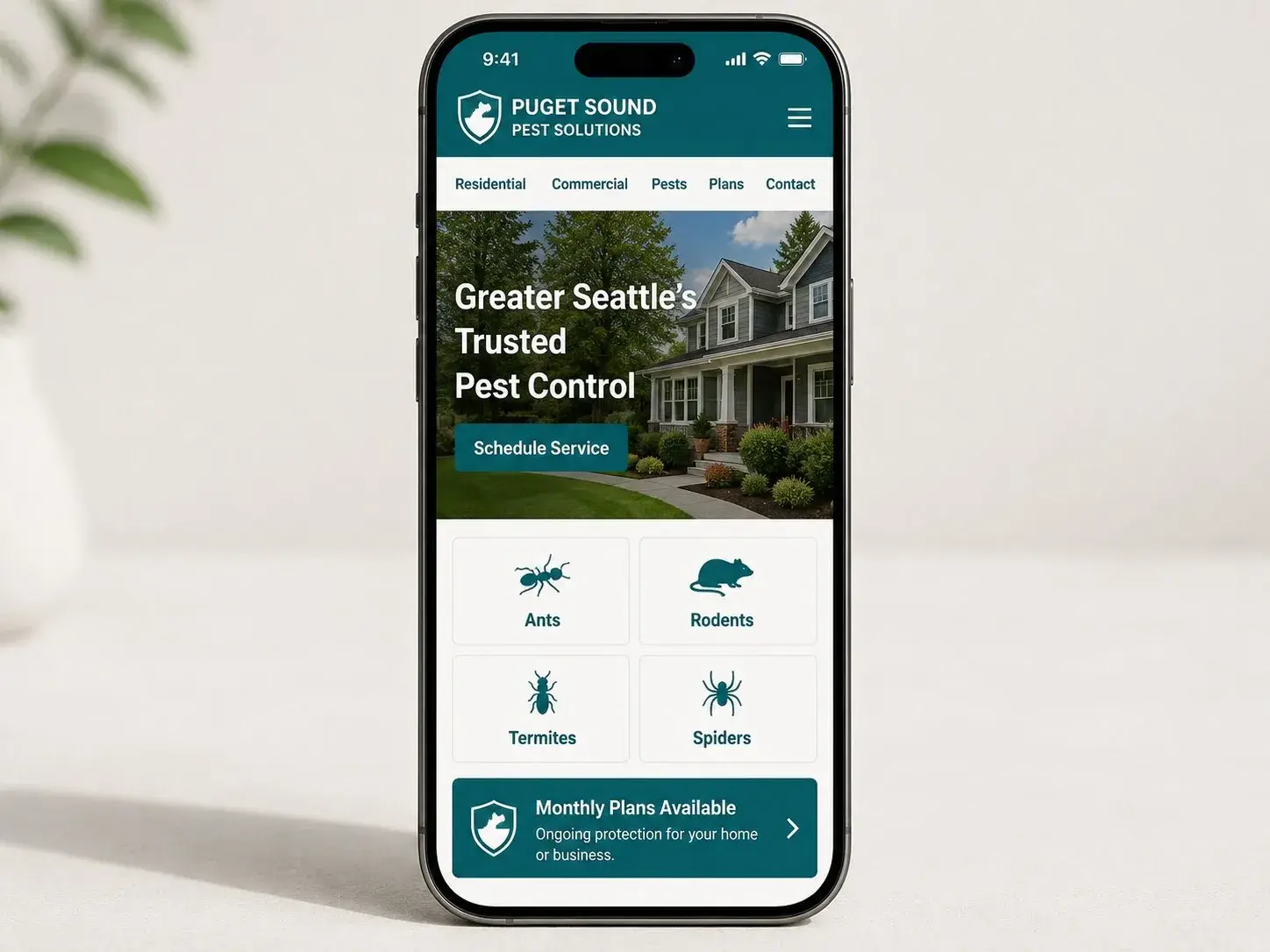
Why Pest Control sites are different.
Pest control has the strongest recurring-revenue economics of any home-service trade. A recurring quarterly customer is worth far more than a single-call customer over time, often several times the revenue across a multi-year relationship. But most pest control sites are still designed around the single-call urgency search ("ants in my kitchen") and convert weakly on the recurring signup. The other lane most existing sites miss is pest-specific landing pages. "Ants Auburn," "rodents Federal Way," "termites Tacoma" each have higher commercial intent than the generic "pest control near me" search, and the existing competition has mostly not built those pages out. Eco-friendly and pet-safe service tiers are a growing differentiator in the Greater Seattle market specifically.
What goes into a great website for pest control companies.
- Pest-specific landing pages
- Separate pages for ants, rodents, spiders, wasps, termites, bed bugs, and the regional specialty pests, each ranking for its own commercial intent rather than diluting one generic pest control page.
- Recurring service signup as the primary CTA
- Quarterly maintenance signup positioned as the default, not the upsell. The recurring economics are too strong to leave behind a single-call CTA. The signup is a short online booking flow, not a "we'll call you back" form, so a homeowner can start service in a couple of taps on their phone while the intent is hot.
- Eco-friendly and pet-safe options surfaced
- Dedicated pages for green/organic treatment options, pet-safe protocols, and family-considerate timing. Growing differentiator in the Seattle market.
- Residential vs commercial split
- Distinct landing pages and intake. Commercial pest control (restaurants, retail, multi-family) has different decision-makers, compliance documentation needs, and longer sales cycles than residential.
- Service-area pages for the cities you actually serve
- Substantive city pages for cities where you do real volume, not templated copies for every Pierce County town. Thin pages hurt overall authority more than they help.
- Recurring billing integration awareness
- Contact form and signup flow that hands off cleanly to your billing system (FieldRoutes, PestPac, GorillaDesk) without double-entry. The signup-to-billing path is the conversion event.
How I approach Pest Control web design.
Every site I build runs on the same modern, server-rendered stack, the same one powering chegtech.com. That's deliberate. The default for local-business sites is WordPress with a page builder, and the builder layer tanks Core Web Vitals and ceiling SEO. Custom-built means faster, cleaner, and built to rank from day one.
A new website doesn't earn Google's full trust overnight. Search engines tend to be cautious with newer domains for the first few months, so I build the foundation correctly from day one, with clean structure, proper SEO, and the right signals in place. That way, as your domain ages and gains authority, your site is already positioned to climb instead of playing catch-up.
SEO + AEO Built In
- Local SEOGBP-aligned content, NAP consistency, citation cleanup, neighborhood pages
- Technical SEOCore Web Vitals in the 90s, semantic HTML, structured data, clean sitemap
- AEO OptimizationFAQ schema, AI-Overview-ready content, ChatGPT/Perplexity citation patterns
- Mobile-First Design70%+ of service searches are mobile, so every page is tested at phone width first
- Schema.org MarkupLocalBusiness, FAQPage, Service schema embedded site-wide
- Conversion TrackingGA4 + GTM + form-submission events wired to real outcomes, not vanity clicks
Tech Stack
- Next.jsReact framework, server-rendered
- AstroContent-first static sites
- TypeScriptType-safe JavaScript
- Tailwind CSSUtility-first styling
- Sveltia CMSGit-based content editor
- NetlifyEdge hosting & deploys
- Cloudflare TurnstileForm spam protection
- Schema.org JSON-LDStructured data for search + AI
- Google Tag ManagerAnalytics + conversion events
- SE RankingKeyword research + rank tracking
- BrightLocalLocal rank tracking + citation audits
- GitHubVersion control + deploy triggers
Recurring-revenue design, not single-call design
Pest control has the strongest recurring economics of any trade, so I would design the quarterly-plan signup as the primary conversion event rather than an afterthought. Around it I would build pest-specific landing pages ('ants Auburn,' 'rodents Federal Way') that carry higher commercial intent than the generic 'pest control near me' search and that the existing competition mostly has not built out.
The Greater Seattle Pest Control market.
Pacific Northwest pest pressure has its own pattern. Carpenter ants are the year-round category-killer in Greater Seattle, with strong spring spikes. Rodents (especially Norway rats) peak in fall as they seek warm cavities. Wasps spike July through September. Active markets: Auburn, Kent, Federal Way, Renton, Puyallup, Tacoma, the South King / South Pierce corridor where 1980s-2000s housing stock has the most carpenter-ant-friendly construction details.
More on the South King County marketCommon Pest Control web design questions.
The signup flow can post to a webhook or email-to-ticket endpoint that your billing system accepts. FieldRoutes, PestPac, and GorillaDesk all support that pattern. Full two-way sync (route optimization, technician schedule writes) is out of scope for a flat-rate build.
Dedicated landing pages for green/organic treatment, pet-safe protocols, and family-considerate timing, with the specific products and active ingredients named where appropriate. The Seattle market specifically responds to genuine eco specifics; generic "green" claims without substance don't clear the bar.
A full custom build is a flat $2,500 one-time, with hosting and maintenance at $150 a month. The pest-specific pages, recurring-signup booking flow, and city pages are all part of that base build. Ongoing local SEO to keep ranking on the pest-and-city terms is an optional $350 to $850 monthly retainer. See pricing →
"Start quarterly service" with a transparent price (e.g. "$89/quarter, no contract") converts better than "Get a free quote." The transparency pre-qualifies serious leads and skips the price-discovery friction that kills the recurring signup. See pricing →
What clients say about working with me.
5.0 rating across 14 Google reviews.
I had an amazing experience working with this website developer! From start to finish, they were professional, responsive, and incredibly skilled. They took the time to understand exactly what I wanted and turned my vision into a beautiful, modern, and fully functional website. The design was clean and user-friendly, the site runs smoothly on all devices, and everything was completed on time. Communication throughout the project was excellent, and they were always willing to make adjustments and provide helpful suggestions. I highly recommend this developer to anyone looking for high-quality web design and development services. Truly a 5-star experience!
Daniel K.
Owner, Velare Remodeling
It's always a privilege to work with someone who truly knows what they're doing and takes pride in their profession. I needed a website for my business and reached out to Jonah from Chegtech. From the start, I was impressed by the quality of his work, his efficiency, and his professionalism. Jonah handled everything in a timely manner and consistently showed respect for my time throughout the entire process. His skills, attention to detail, and commitment to delivering excellent results made the experience smooth and stress-free. I'm extremely satisfied with the outcome and would highly recommend him to anyone looking for a reliable and talented web developer.
Natalya C.
Real estate client
Amazing Service offered, ChegTech responded very quickly and helped me get my website up and running. Offered lots of help so would definitely recommend to business/individual looking to get a professional website for a good price.
Joshua S.
Verified Google review

Every Pest Control site is designed, coded, and optimized by Jonah Chegarnov. No subcontractors, no account managers, no handoffs. Founder of ChegTech · Web Designer & SEO in Auburn, WA.
More about JonahReady to talk about your Pest Control project?
Project-by-project. No retainers, no contracts. Starting at $2,500.
ChegTech · Auburn, WA 98001 · serving Greater Seattle · (206) 940-8704 · jonah@chegtech.com