
Website for auto repair shops that wins the appointment on trust.
A website for auto repair shops wins the appointment on trust and transparency. Drivers wary of being overcharged relax the moment your site shows certifications and real reviews up front, and that's how I build it. It ranks well locally and keeps climbing as it builds authority, and it encourages satisfied customers to leave reviews, so your reputation keeps building.
By Jonah Chegarnov · Updated
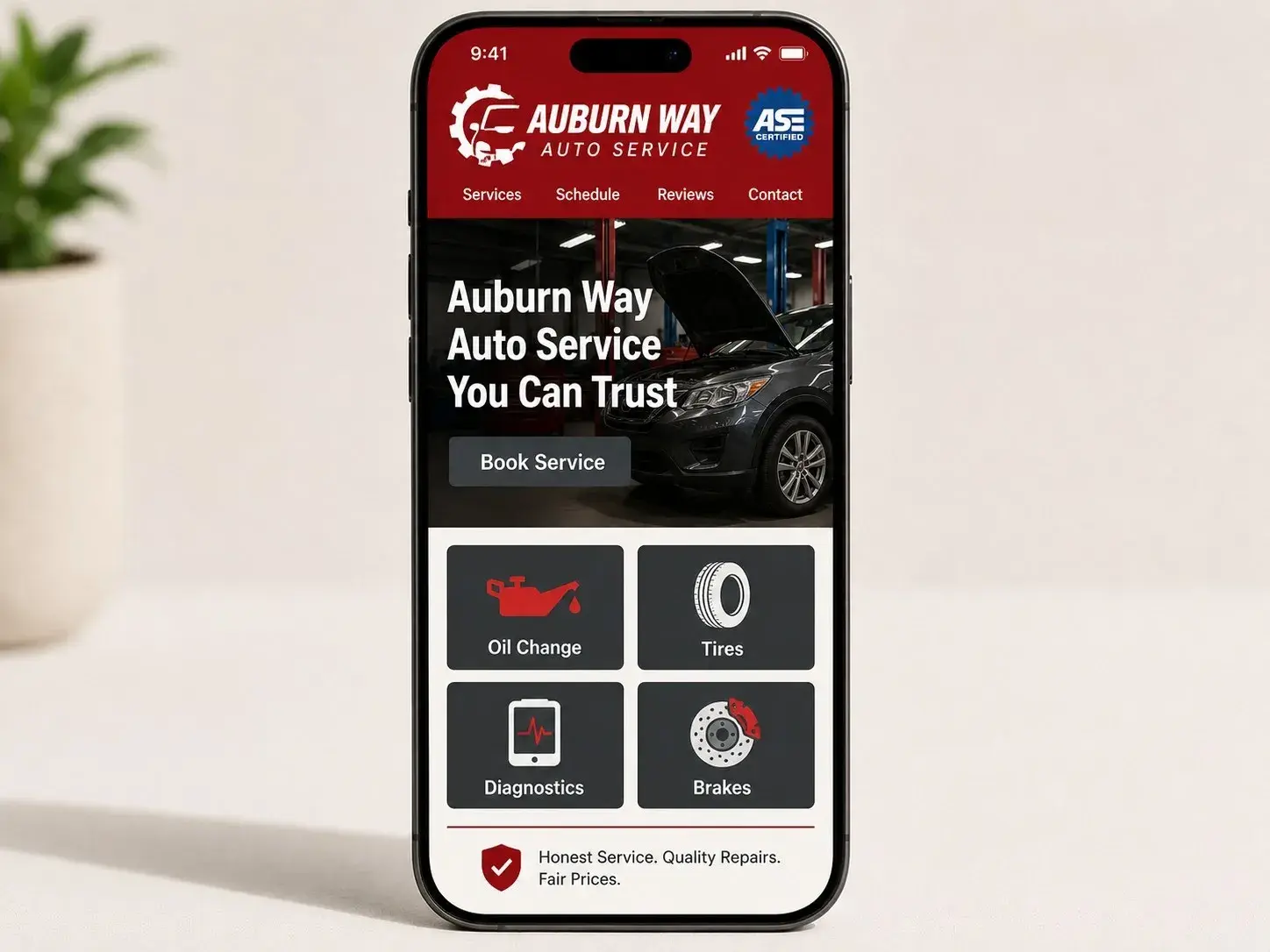
Why Auto Service sites are different.
Auto service customers are deeply suspicious by default, bad mechanic experiences are common cultural touchstones, and that baseline distrust changes what the site has to do before it can convert. ASE certification, BBB rating, real review velocity (recent, specific, named), and price transparency are the trust-clearing levers. Vague "competitive pricing" copy or stock images of a mechanic at a wrench fail to clear the bar. Beyond trust, the search behavior splits into two clean lanes: ready-to-act searches ("oil change near me," "brake repair Auburn," "mechanic open Saturday") that convert on proximity and availability, and pre-research searches ("best transmission shop Pierce County," "why is my car making this noise") that convert on expertise content. Saturday hours are gold in this category, explicit weekend hours convert disproportionately.
Sources: ASE, National Institute for Automotive Service Excellence
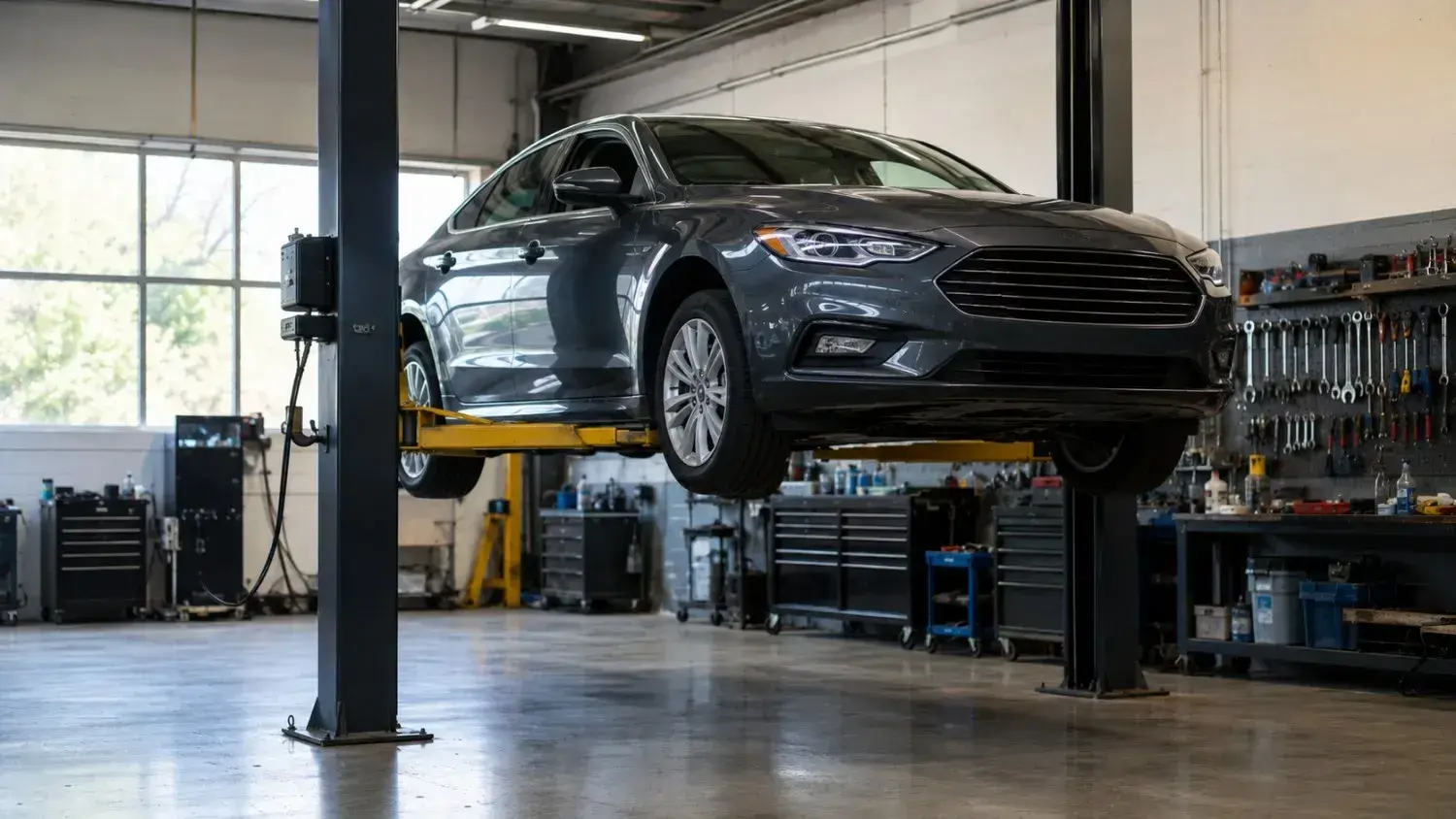
What goes into a great website for auto repair shops.
- ASE / BBB / certifications visible by default
- Trust badges in the header and footer, not buried on the about page. Specific certifications named (ASE Master Tech, BBB A+, AAA Approved) rather than vague "certified mechanics" copy.
- Service pages with real price ranges
- Oil change, brake repair, alignment, transmission, diagnostics, each its own page with realistic price ranges that pre-qualify leads. Transparency outperforms "call for a quote" on every measurable conversion metric.
- Saturday hours surfaced explicitly
- Weekend availability is one of the highest-converting trust signals for auto service. "Open Saturdays 8am-4pm" in the header beats generic "flexible scheduling" by a wide margin.
- Real review schema with specifics
- Google Reviews integration with review schema. Recent reviews that mention specific repairs ("replaced my Subaru's CV joints") convert better than generic five-star reviews.
- Online appointment booking
- Calendar-integrated booking for routine service (oil changes, tire rotations, scheduled maintenance), so a driver can lock a slot at 11pm without waiting for the shop to open. Diagnostic and major repair work routes to a call-back form because the scope can't be quote-booked online.
- Service-area pages for the cities you actually serve
- Substantive pages for the cities driving real volume. Most auto service shops draw from a 10-15 mile radius; the service-area schema should reflect that honestly.
How I approach Auto Service web design.
Every site I build runs on the same modern, server-rendered stack, the same one powering chegtech.com. That's deliberate. The default for local-business sites is WordPress with a page builder, and the builder layer tanks Core Web Vitals and ceiling SEO. Custom-built means faster, cleaner, and built to rank from day one.
A new website doesn't earn Google's full trust overnight. Search engines tend to be cautious with newer domains for the first few months, so I build the foundation correctly from day one, with clean structure, proper SEO, and the right signals in place. That way, as your domain ages and gains authority, your site is already positioned to climb instead of playing catch-up.
SEO + AEO Built In
- Local SEOGBP-aligned content, NAP consistency, citation cleanup, neighborhood pages
- Technical SEOCore Web Vitals in the 90s, semantic HTML, structured data, clean sitemap
- AEO OptimizationFAQ schema, AI-Overview-ready content, ChatGPT/Perplexity citation patterns
- Mobile-First Design70%+ of service searches are mobile, so every page is tested at phone width first
- Schema.org MarkupLocalBusiness, FAQPage, Service schema embedded site-wide
- Conversion TrackingGA4 + GTM + form-submission events wired to real outcomes, not vanity clicks
Tech Stack
- Next.jsReact framework, server-rendered
- AstroContent-first static sites
- TypeScriptType-safe JavaScript
- Tailwind CSSUtility-first styling
- Sveltia CMSGit-based content editor
- NetlifyEdge hosting & deploys
- Cloudflare TurnstileForm spam protection
- Schema.org JSON-LDStructured data for search + AI
- Google Tag ManagerAnalytics + conversion events
- SE RankingKeyword research + rank tracking
- BrightLocalLocal rank tracking + citation audits
- GitHubVersion control + deploy triggers
The Auburn Way corridor playbook
Auburn Way is one of the densest auto-service corridors in South King County, and the local search behavior here rewards trust-clearing sites with transparent pricing. The full breakdown of how the Auburn Way market works (pre-research vs ready-to-act funnels, GBP categories, the Saturday-hours edge) is in the linked article.
Read the Auburn Way playbook →The Greater Seattle Auto Service market.
Auburn Way (North and South) is the densest auto corridor in South King County, with dozens of dealers and independents along a 6-mile stretch. The same pattern repeats at smaller scale in Federal Way (Pacific Highway South), Renton (Rainier Ave), and Tacoma (Pacific Avenue). The independents that win consistently are the ones with real Saturday hours, specific certifications, and recent review velocity, not the ones with the slickest sites.
More on the Auburn marketCommon Auto Service web design questions.
Real ranges per service. "Oil change $59 to $89 depending on synthetic blend" beats "Affordable oil changes." "Brake pad replacement $250 to $400 per axle" beats "Competitive brake pricing." Customers are price-shopping anyway; transparency wins the trust comparison.
No, and you shouldn't pretend it does. Online booking for routine service (oil, tires, alignment, scheduled maintenance) works cleanly. Diagnostic and major repair need a call-back form because the actual scope can't be determined from a booking widget. Trying to force online booking on diagnostic work damages the customer relationship at the first interaction.
Ask every completed-service customer once, 24-48 hours after pickup, via a one-message text with the direct Google review link. Don't ask twice. Don't ask for specific star ratings. That cadence keeps review velocity steady without triggering Google's spam detection in automotive specifically (where the spam-pattern bar is sensitive).
LSAs are available for some automotive categories (specifically auto repair as of 2025) in select markets. Worth running if your market is LSA-eligible, the Google Guaranteed badge converts disproportionately well in automotive where trust is the entire purchase decision. See SEO services →
What clients say about working with me.
5.0 rating across 14 Google reviews.
ChegTech, did a fantastic job for glass installation company. Super easy to work with, would highly recommend for anyone looking to get a website done right. Will use them again for any future business endeavours.
Tima C.
Owner, IGo Green
I had an amazing experience working with this website developer! From start to finish, they were professional, responsive, and incredibly skilled. They took the time to understand exactly what I wanted and turned my vision into a beautiful, modern, and fully functional website. The design was clean and user-friendly, the site runs smoothly on all devices, and everything was completed on time. Communication throughout the project was excellent, and they were always willing to make adjustments and provide helpful suggestions. I highly recommend this developer to anyone looking for high-quality web design and development services. Truly a 5-star experience!
Daniel K.
Owner, Velare Remodeling
It's always a privilege to work with someone who truly knows what they're doing and takes pride in their profession. I needed a website for my business and reached out to Jonah from Chegtech. From the start, I was impressed by the quality of his work, his efficiency, and his professionalism. Jonah handled everything in a timely manner and consistently showed respect for my time throughout the entire process. His skills, attention to detail, and commitment to delivering excellent results made the experience smooth and stress-free. I'm extremely satisfied with the outcome and would highly recommend him to anyone looking for a reliable and talented web developer.
Natalya C.
Real estate client

Every Auto Service site is designed, coded, and optimized by Jonah Chegarnov. No subcontractors, no account managers, no handoffs. Founder of ChegTech · Web Designer & SEO in Auburn, WA.
More about JonahReady to talk about your Auto Service project?
Project-by-project. No retainers, no contracts. Starting at $2,500.
ChegTech · Auburn, WA 98001 · serving Greater Seattle · (206) 940-8704 · jonah@chegtech.com